

Episode 325: Hidden Connection Between Your Spine & Nervous System Regulation with Dr. Veronica Schiltz
Jan 20, 2026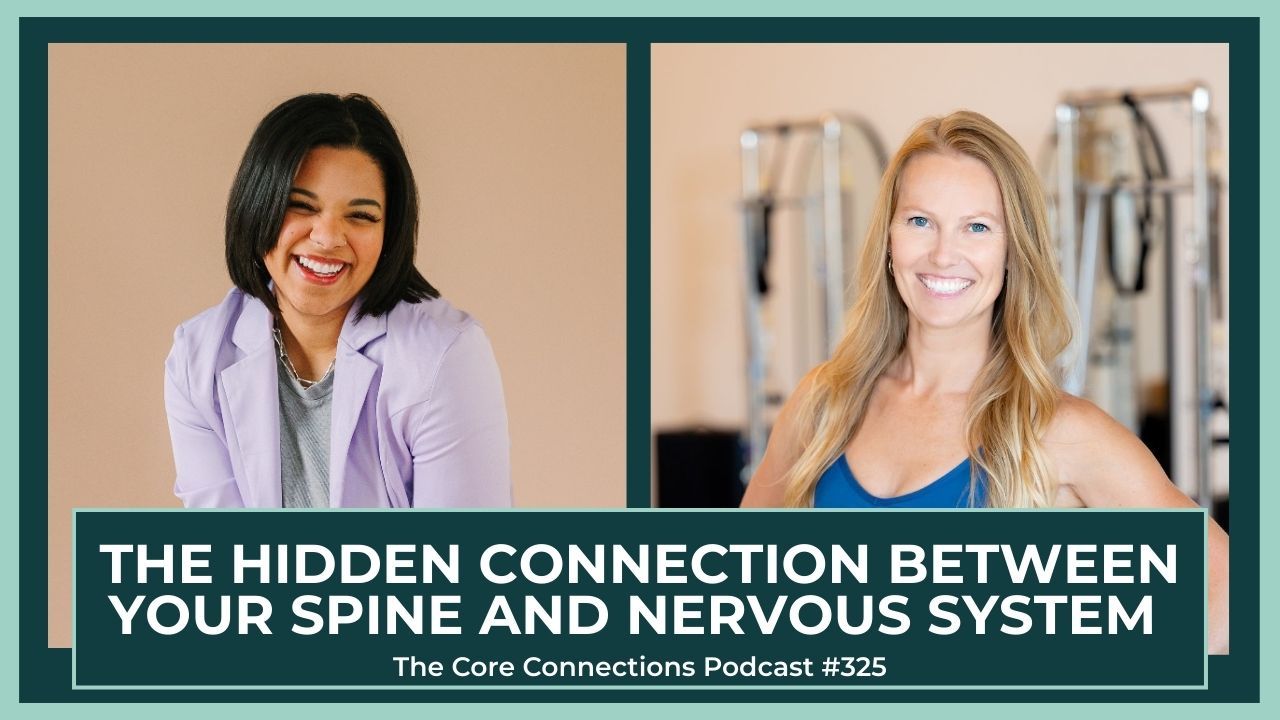
Hidden Connection Between Your Spine & Nervous System Regulation with Dr. Veronica Schiltz
“When mom’s nervous system feels better — when it’s more balanced and regulated — everyone around her feels it. The house feels calmer. The kids feel calmer. The baby feels calmer. It’s not just about mom feeling better; it changes the entire environment.” Dr. Veronica Schiltz
This simple truth explains so much of what so many women experience — especially during pregnancy, postpartum, and the busy seasons of motherhood.
If you’ve ever noticed that when you’re overwhelmed, exhausted, or running on empty, everyone around you feels more on edge too… that’s not a coincidence. Your nervous system is constantly communicating with the people closest to you.
And when it’s stuck in survival mode — no matter how “healthy” you’re trying to be — your body, your energy, and your ability to heal will always feel limited.
On my recent episode of the Core Connections Podcast, I sat down with my friend and colleague Dr. Veronica Schiltz, a PX Doc and chiropractor who specializes in gentle, nervous system–focused care, to explore why regulation is the true foundation of healing — and why helping mom feel better often helps the whole family feel better too.
>>LISTEN HERE<<<
00:00 – Welcome & why nervous system regulation matters more than ever
03:30 – What nervous system–focused chiropractic care really means
07:45 – How chronic stress, pregnancy, and life experiences shape the nervous system
12:40 – Why gentle care is often more effective than force
17:20 – Understanding nervous system scans & what they reveal
22:30 – Posture as a reflection of nervous system health
27:15 – Why “doing everything right” still leads to exhaustion
33:10 – Survival mode vs. true regulation
40:00 – How a regulated mom impacts babies, kids, and the whole household
47:00 – Honoring the body instead of criticizing it
52:30 – Healing timelines, patience, and long-term nervous system support
56:30 – Final thoughts & where to learn more
What Makes This Approach Different?
Traditional chiropractic care often focuses on pain relief and structural alignment. You go in with back pain, get adjusted, feel better temporarily, and come back when the pain returns. It's a cycle many of us know well.
Dr. Veronica's practice is fundamentally different. As a PX Doc (Pediatric Experience Doctor), she's trained to work with the nervous system in a way that promotes lasting change rather than temporary relief.
'We start and stay in the nervous system,' Dr. Veronica explains. 'The spine is basically just our way of getting into the nervous system. I don't talk about posture in the traditional chiropractic sense of sit up straight. I observe your posture because it tells me what's happening in your nervous system.'
The Three-Step Process: Listen, Look, and Adjust
Dr. Veronica's approach breaks down into three essential components:
1. Deep Listening
The journey begins with an extensive intake that might surprise you. Dr. Veronica asks about your birth story--yes, even for adults. Why? Because if you've been stuck in a stress pattern since birth, that fundamentally changes how she approaches your care.
'I want to know all of the different routes you've taken to get to this point,' she says. 'We see a lot of people who have gone through several providers and they're being told they're making it up or that nothing can be found. That's when they come to my office.'
2. Objective Assessment
Next comes the scan work. Dr. Veronica uses three different non-invasive surface scans (Insight scans) that provide objective data about what's happening in your nervous system. These aren't looking at specific vertebrae to adjust--they're revealing patterns.
'We don't base your entire care plan on one scan's finding,' she explains. 'We base it on the story your three scans are telling me and what pattern I can follow to unwind the nervous system.'
These scans are repeated every 6-12 visits to track progress and adjust the approach as your nervous system changes.
3. Gentle, Targeted Adjustments
Here's where it gets really interesting. Dr. Veronica only adjusts one to three things per visit. That's it.
'I don't want to overwhelm an already overwhelmed nervous system,' she says. The adjustments are so gentle that sometimes there's no 'pop' at all. What she's looking for isn't a shift in one joint--it's full body integration.
She calls this 'tonal work,' similar to craniosacral therapy. The goal is to help your nervous system release and integrate information it's been holding onto, without adding more input to an already stressed system.
Imagine Your Brain at a 24/7 Rave Concert
Dr. Veronica uses a powerful analogy to explain nervous system dysregulation: 'Could you imagine if your brain was at a 24/7 rave concert? It's just noisy all the time. You can discipline that. You can create boundaries. But until you turn the music down, you're screaming into a nervous system that's already screaming.'
This is why all your efforts to eat better, exercise more, or practice self-care feel like such an uphill battle. Your nervous system has been cranked to 100,000 for so long that it doesn't know how to do anything else.
Why 'Pushing Through' Doesn't Work
For high-functioning women (which describes most of Dr. Veronica's clients), the instinct is always to do more. More workouts, more productivity, more optimization.
But here's the problem: you can't listen to something you can't hear.
'Your body naturally wants to listen to itself,' Dr. Veronica explains. 'There was just something that taught it not to.'
Athletes, she notes, are often her hardest clients because they've trained themselves to ignore their bodies to such an extreme degree. Their brains and bodies are completely disconnected, and her job is to help them reconnect those dots.
Nervous System Regulation Isn't About Always Being Calm
One of the biggest misconceptions about nervous system work is that the goal is to always be in a calm, zen state. Dr. Veronica offers a more nuanced view:
'Slowing down isn't actually nervous system regulation. It's the ability to have the choice to do either. The ability to go to sleep at 8 PM without letting your brain override that need, but also the ability to stay up late and focus on what you need to do without taking away from your capacity.'
True regulation means you can access both states--activation when you need it, rest when you need it--without getting stuck in either extreme.
Many people swing between extremes: three days of complete shutdown (sleeping, crying, unable to function) followed by guilt-driven overdrive. Both sides of this pendulum are dysregulation. Healing happens in the middle, where you have genuine choice.
Why Healing Takes Time (And Why That's Okay)
In our quick-fix culture, the idea of a four-and-a-half-month healing program might seem excessive. But Dr. Veronica offers a perspective shift:
'When we started, we went from birth. If I can track some of the things you've been having since birth, four and a half months really doesn't seem that long. This is a whole lifeline journey.'
She emphasizes that we tend to compartmentalize our past--stressful childhood here, big trauma there, difficult job period over there. But your nervous system doesn't work in boxes. It's all one big container of experiences that have shaped how your system operates today.
What to Expect: The 'Neuro Detox'
Don't be surprised if you feel worse before you feel better. Dr. Veronica calls this a 'neuro detox,' and it's actually a sign that things are working.
'I'm not undoing anything new to your nervous system,' she explains. 'I am uncovering what you ran away from. A lot of people don't want to deal with the hard that it takes to go through healing.'
Symptoms can include fatigue, vivid dreams, emotional releases, or even physical symptoms like nausea. In children, you might see temporary regression (like a toddler starting to crawl again if they skipped that developmental stage).
The key is that the only way through it is through it. But this time, you have support and tools to process what you couldn't before.
Breaking Generational Stress Patterns
One of the most fascinating aspects of Dr. Veronica's work is how it addresses generational stress patterns, especially during pregnancy and early childhood.
Your nervous system begins forming at 4-6 weeks in utero, and for those nine months, baby's nervous system is in constant communication with mom's. If mom is stressed, baby's nervous system learns to match that state--not as a flaw, but as a protective mechanism.
'It's safety,' Dr. Veronica explains. 'If a baby comes out and mom's stressed out, they need to understand the world they're coming into. It's also a connecting mechanism so they can bond better.'
This is why she emphasizes that when the mom is regulated, the whole family thrives. Mom is modeling what the nervous system should do for everyone around her, including her partner and children.
How to Find a Provider Like Dr. Veronica
Dr. Veronica is part of a certification program called PX Docs (Pediatric Experience Doctors), which has strict standards for who can join and stay certified. The program requires ongoing education because understanding of the nervous system is constantly evolving.
You can find a PX Doc directory at pxdocs.com. The program is growing internationally, with providers across the United States and beyond.
If there's no PX Doc in your area, Dr. Veronica recommends looking for a chiropractor who works with babies. 'You have to have some level of tonal work to work with a baby,' she notes. 'They can't use heavy mechanical adjustments with infants, so they've learned gentler techniques that can also benefit adults.'
Tools You Can Use Right Now
While Dr. Veronica's work is unique, there are practices you can incorporate on your own to support nervous system regulation:
Breath Work
Your breath is one of the few bodily functions that operates both automatically and voluntarily. This makes it a powerful tool for influencing your autonomic nervous system.
'When you channel that breathing, you're also addressing your autonomic nervous system to hopefully slow things down and calm down,' Dr. Veronica explains.
Meditation and Stillness
Find a meditation practice that works for you--whether that's traditional meditation, prayer, or focused attention on something meaningful. The goal isn't to empty your mind but to give your brain something to focus on that allows it to settle.
Gentle Movement
Slow, intentional movement practices like gentle Pilates or fascial ball rolling can help you reconnect with your body. The key is to go slow enough that you can actually feel what's happening, closing your eyes when possible to deepen the internal awareness.
Practice Doing Nothing
'If you can just sit in a room and do nothing for like one second,' Dr. Veronica suggests. Even three minutes can be challenging for people with dysregulated nervous systems. Start small and build from there.
Beyond Physical Symptoms: Life Changes
One surprising side effect of nervous system regulation is how it can catalyze major life changes. Dr. Veronica has seen clients change jobs, end relationships, start homeschooling, or make other significant shifts.
'You're in your profession, you're in that relationship, you're in whatever situation because of the survival state you're in,' she explains. 'Once you get out of that survival state, it is so hard to integrate back into a lifestyle that your nervous system never was really wanting in the first place.'
When you're no longer operating from survival mode, you suddenly have choices you couldn't see before--and the capacity to do something about them.
Honoring Your Journey
Perhaps the most important message from Dr. Veronica is about self-compassion:
'Get curious instead of getting annoyed or critical or shame-filled about something that your body is doing. It's there for a reason. It was ultimately there for your protection. Honor your body and the journey you've been through--you've been through a lot.'
Your nervous system has done an amazing job keeping you safe and functional through whatever you've experienced. The goal now isn't to criticize it for being stuck in survival mode--it's to help it shift from surviving to thriving.
Every part of your journey has value. You haven't done anything wrong. You're simply ready for the next level.
Ready to Take the Next Step?
If you're in the Ankeny, Iowa area, you can find Dr. Veronica at Haven Health Chiropractic havenhealthchiropractic.com or @havenhealthchiropractic on Instagram.
If you're not local, visit pxdocs.com to find a certified Pediatric Experience Doctor in your area.
And remember: whether you're dealing with exhaustion, pain, anxiety, or just feeling stuck, your nervous system holds the key to moving forward. It's not about doing more--it's about addressing what's been there all along.
Your body has been working so hard to keep you safe. Now it's time to help it heal.
Support Your Nervous System Through Core Rehab®
Healing doesn’t come from pushing harder — it comes from supporting your nervous system.
My Core Rehab Program is gentle, breath-led, nervous system–informed movement designed to help you feel safer in your body while rebuilding true core and pelvic floor support.
When your nervous system feels supported, your body can finally respond.
👉 Learn more about Core Rehab® and begin moving in a way that supports healing


