Become the Kind of Instructor Who Sees More.
Core Athletica® Movement Specialist + Comprehensive Pilates Instructor Training
Learn to see the body differently, understand movement at a deeper level, and become more confident knowing what to teach, why you're teaching it, and how to adapt movement for the person in front of you.
Whether you want to deepen your expertise as a movement professional or become a comprehensively trained Pilates equipment instructor, your education begins with learning how the body moves as an interconnected system.
Choose the training pathway that fits where you want to go.
EXPLORE THE TWO PATHWAYS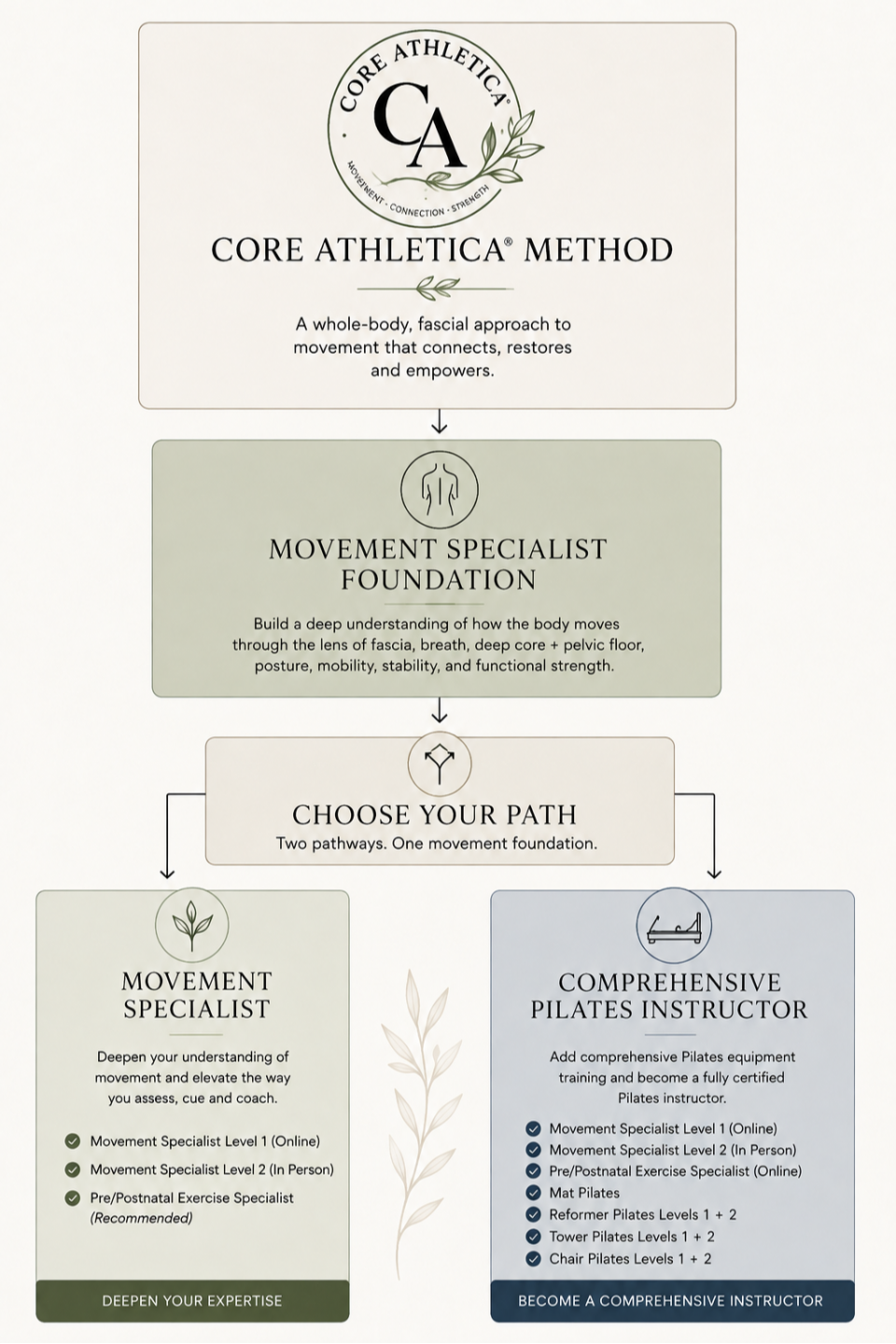
This Isn't Just About Learning More Exercises.
There are plenty of trainings that can teach you exercises.
I want to teach you how to understand movement.
After more than 20 years of teaching, I've found that knowing a large repertoire of exercises doesn't automatically make someone an exceptional instructor.
The real skill is learning how to see the body in front of you.
- Why is one hip moving differently than the other?
- Why does someone continually feel an exercise in their hip flexors or low back?
- Why isn't their deep core connecting the way you expect?
- Where are they gripping, compensating or lacking mobility?
- Could the restriction you're seeing in one area actually be connected to something happening somewhere else?
And most importantly...
What can you do about it?
That's the deeper level of thinking I want you to develop through the Core Athletica® Method.
Learn to Look Beyond Individual Muscles.
Traditional anatomy education often teaches us to think about the body muscle by muscle:
This muscle does this.
This exercise strengthens that.
But that's not how your body actually moves.
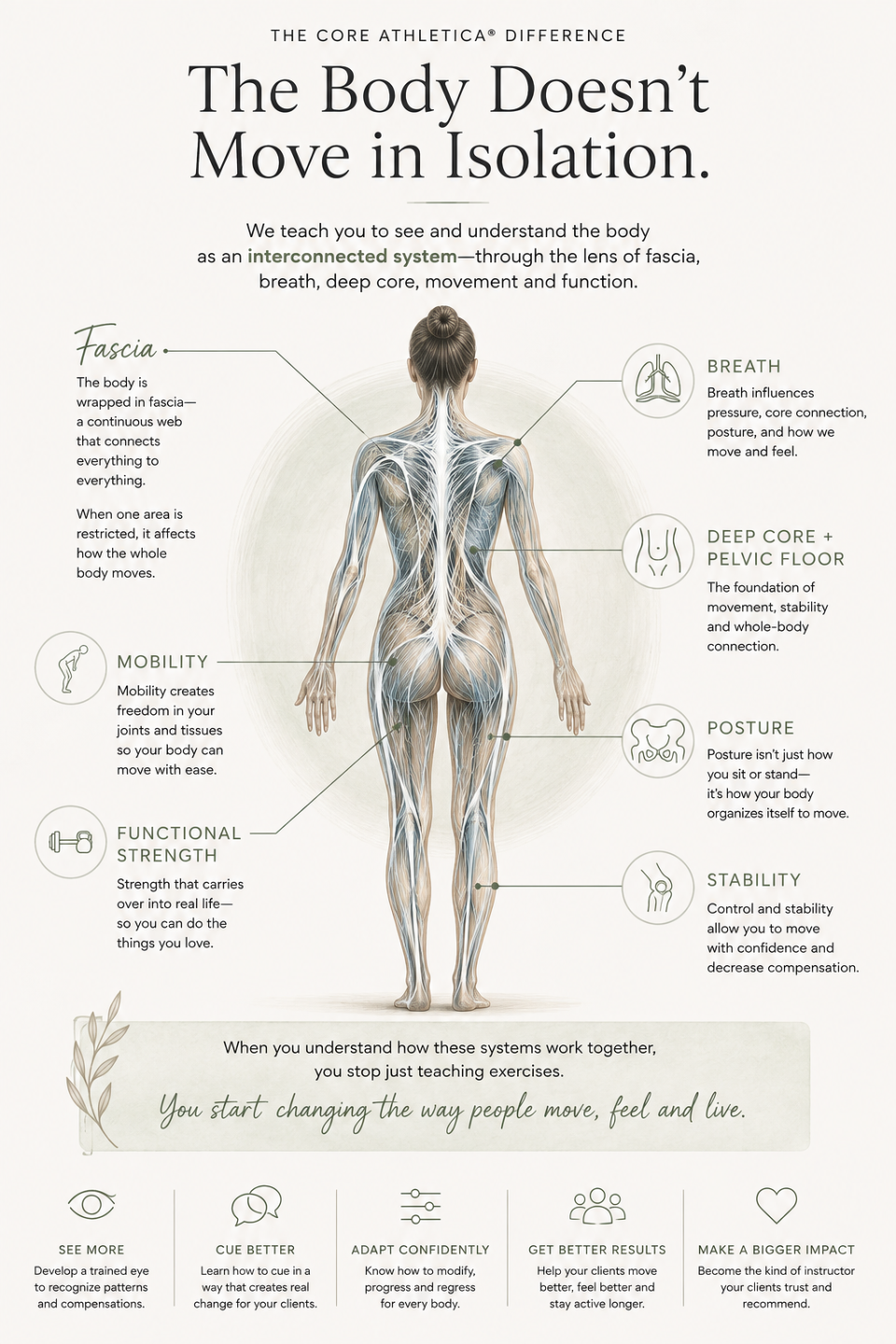
Your fascia connects your body from head to toe.
Muscles, fascia, joints, breath, posture, the nervous system, deep core and pelvic floor are constantly influencing one another.
That's why a major part of the Core Athletica® Method is learning to look at movement through a fascial and whole-body perspective.
Instead of only asking:
"What muscle needs to be stronger or stretched?"
You'll begin asking:
"What is preventing this body from moving well?"
You may discover that what looks like weakness isn't simply a strength problem.
There may be restriction somewhere else along the fascial system. A breathing pattern may be affecting pressure management. Posture may be changing someone's ability to access their deep core. A lack of mobility may be causing another area to compensate.
This changes the way you look at movement.
And it changes the way you teach.
Learn to Connect the Dots
Throughout your training, you'll learn to bring together:
Fascia + Whole-Body Connections
Begin seeing beyond isolated muscles and recognizing how restrictions and movement patterns in one area can influence another.
Deep Core + Pelvic Floor
Understand how the diaphragm, pelvic floor and deep core work together—and how to integrate that connection into movement rather than treating the "core" as a separate set of exercises.
Breath + Pressure Management
Learn how breathing patterns can influence posture, core function, pelvic floor function and movement.
Mobility + Stability
Develop a better eye for determining when someone needs more mobility, more stability—or a different strategy altogether.
Posture + Alignment
Learn to recognize patterns without trying to force every body into one "perfect" position.
Functional Strength
Take the principles beyond Pilates so your clients can build strength that carries into everyday life and the activities they love.
Cueing + Visualization
Learn how the words you use can completely change the way someone experiences and performs a movement.
Movement Assessment + Compensations
Develop your ability to recognize what the body may be communicating through its movement patterns and use that information to guide what you teach next.
An Education You'll Use for the Rest of Your Career
You're not just earning a certification. You're developing the skills to become the kind of movement professional people trust with their bodies.
There are faster ways to earn a certification.
But if you're going to invest your time, energy and money into becoming a movement professional or enhancing your current skillset, I believe your education should prepare you for more than passing an exam or memorizing a repertoire of exercises.
It should prepare you for the real people who will walk through your door.
Bodies with different histories. Different limitations. Different movement patterns. Different goals.
Clients who don't feel an exercise where they're "supposed to."
Clients who compensate, grip or struggle to connect with their deep core.
Clients who need you to recognize when to strengthen, when to create mobility, when to change the movement—and when to simply change the way you're cueing it.
That's where deeper education matters.
Through the Core Athletica® Method, you'll develop principles and a way of looking at the body that you can carry with you throughout your career.
You'll learn to observe more closely, ask better questions, understand whole-body connections and make more confident decisions about the movement you're teaching.
Because the goal isn't simply to leave with more exercises in your toolbox.
It's to leave understanding the body differently.
So as your clients change, your career evolves and your own knowledge continues to grow, you'll have a foundation that allows you to keep learning, adapting and becoming a better instructor.
You're not just earning a certification. You're developing the skills to become the kind of movement professional people trust with their bodies.
Two Pathways. One Movement Foundation.
Your goals may be different from the person training beside you.
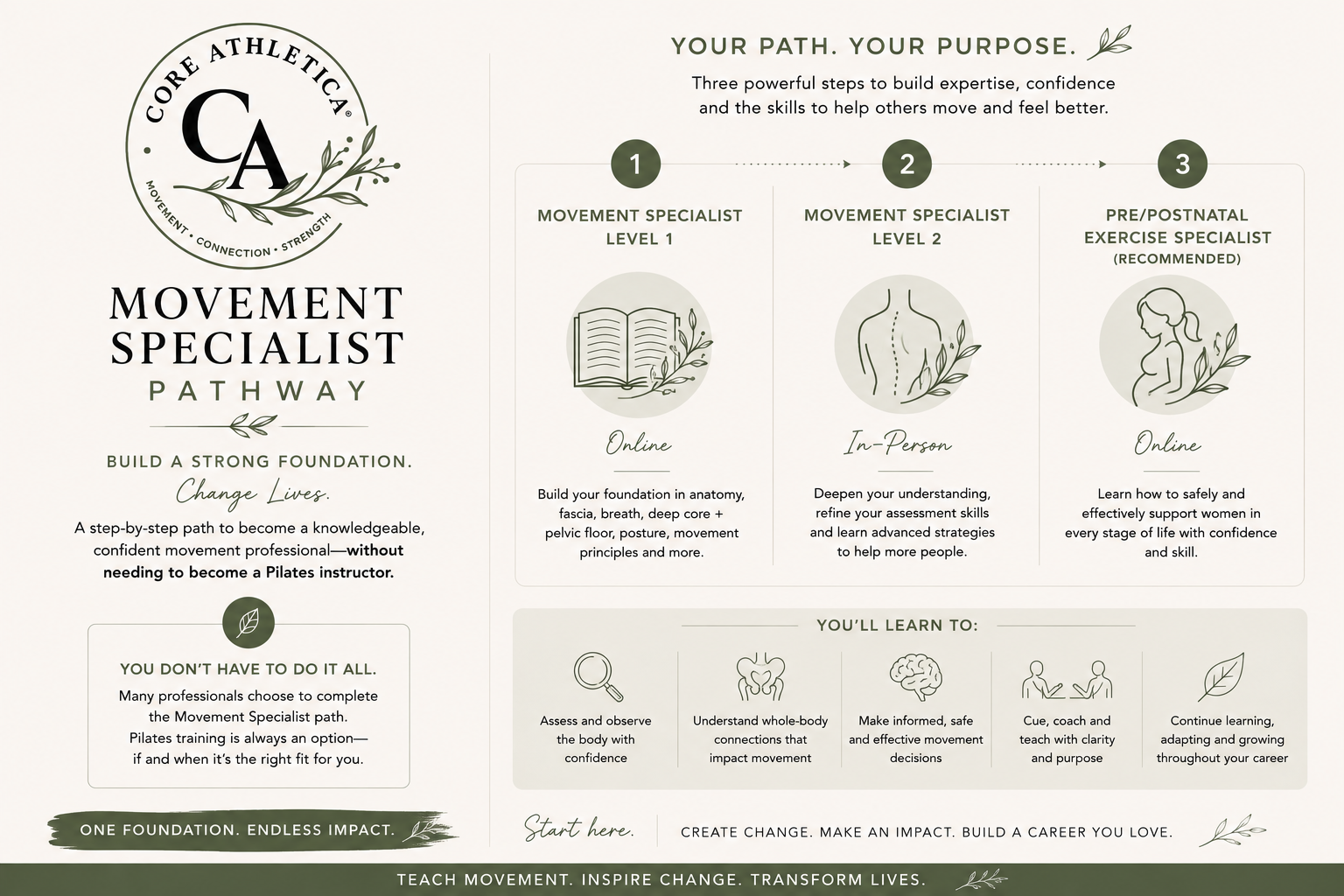
Pathway 1
Become a Core Athletica® Movement Specialist
For professionals who want to deepen their understanding of the body and become better at assessing, cueing and teaching movement.
This pathway is a great fit if you're already a:
-
Pilates or fitness instructor
-
Personal trainer
-
Physical therapist
-
Healthcare or wellness professional
-
Movement professional
Or if you simply want a deeper education in how the body moves without becoming a comprehensive Pilates equipment instructor.
Your Training Includes:
Movement Specialist Level 1 — Online
Build your foundation in the Core Athletica® Method and begin learning to look at movement through the lens of fascia, deep core + pelvic floor function, breath, posture, mobility, compensations and whole-body connection.
Movement Specialist Level 2 — In Person
Take those concepts deeper through hands-on application, movement assessment, case studies, coaching and advanced cueing.
Recommended Addition:
Pre/Postnatal Exercise Specialist — Online
If you work with women, I highly recommend adding this certification.
Pregnancy and postpartum can have lasting effects on the core, pelvic floor, breathing mechanics, posture and movement patterns. Understanding these changes can make you a much more informed movement professional—even if prenatal and postpartum clients aren't your primary focus.
You can stop here and use your Movement Specialist education within the work you already do—or continue into the Comprehensive Pilates Instructor pathway.
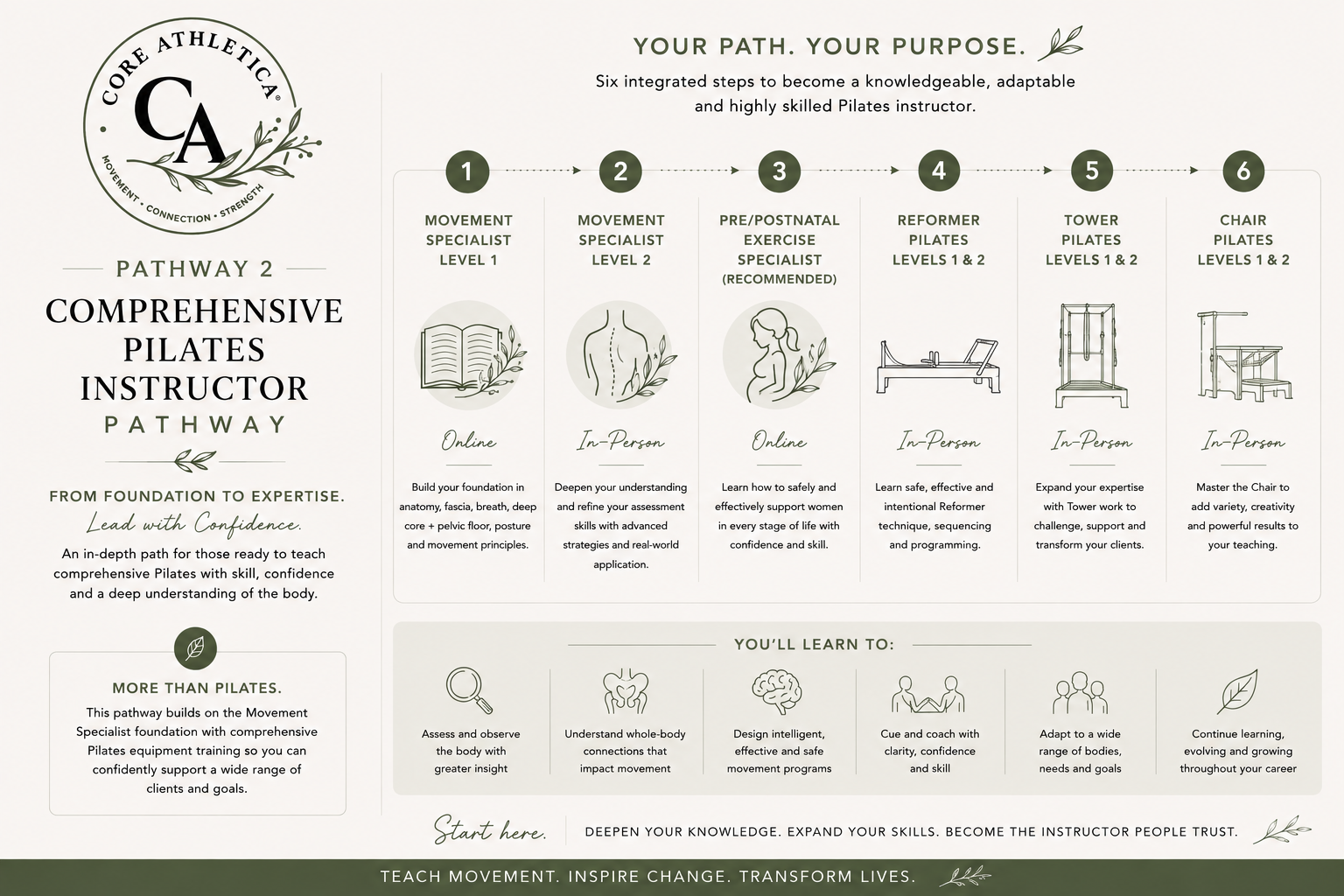
Pathway 2
Become a Movement Specialist + Comprehensive Pilates Instructor
For those who want the deeper movement education PLUS comprehensive training on Pilates equipment.
You'll begin with the same Movement Specialist foundation and then learn how to apply those principles across Mat Pilates and the major pieces of Pilates equipment.
Your Comprehensive Training Includes:
-
Core Athletica® Movement Specialist Level 1
-
Core Athletica® Movement Specialist Level 2
-
Pre/Postnatal Exercise Specialist
-
Mat Pilates Level 1
-
Reformer Pilates Levels 1 + 2
-
Tower Pilates Levels 1 + 2
-
Chair Pilates Levels 1 + 2
Plus your observation hours, personal practice, teaching practice hours, written testing and practical examinations required to complete your comprehensive certification.
This pathway is designed to give you both the depth of a Movement Specialist and the comprehensive equipment education of a Pilates instructor (levels 1 & 2).
Become More Than Someone Who Knows Pilates.
Which Pathway is Right for You?
- Become the instructor who understands why he/she's teaching what he/she's teaching.
- The instructor who notices the small things.
- The instructor who can adapt instead of simply following a sequence.
- The instructor who understands that the body doesn't move as a collection of isolated muscles—but as an interconnected system.
- And the instructor whose education continues to influence the way she teaches for years to come.
MOVEMENT SPECIALIST
Deepen your movement expertise without pursuing comprehensive Pilates equipment certification.
MOVEMENT SPECIALIST + COMPREHENSIVE PILATES INSTRUCTOR
Complete the full Movement Specialist education plus Mat, Reformer, Tower and Chair training.
Meet Erica Ziel
Creator of the Core Athletica® Method
More Than 20 Years of Teaching Movement
For more than 20 years, I've been studying, teaching and continually evolving the way I look at the body and movement.
I'm a movement educator, Core Exercise Specialist, certified Pilates instructor, personal trainer, pre/postnatal exercise specialist and Functional Diagnostic Nutrition Practitioner—but some of my greatest education has come from the thousands of women I've had the opportunity to teach over the years.
Because real bodies don't always move the way a textbook says they should.
That's what has continued to shape the Core Athletica® Method and the way I train instructors today.
I Want to Teach You How to See the Body Differently.
Early in my career, I learned anatomy much like everyone else—muscles, origins, insertions and individual actions.
But the longer I taught, the more I realized that looking at muscles in isolation wasn't enough.
I became fascinated by fascia, whole-body movement, the deep core + pelvic floor, breath, posture, mobility and the subtle compensations that can completely change how someone moves.
I began connecting the dots.
And it changed the way I taught + the results I was able to get my clients!
Today, the Core Athletica® Method brings together my decades of experience in Pilates, functional strength, fascia-based movement, deep core + pelvic floor function, breath, mobility, posture and pre/postnatal movement to help instructors understand the body as an interconnected system.
Throughout my career, I've had the opportunity to:
- Teach Pilates and movement for more than two decades
- Work with women through pregnancy, postpartum, pelvic floor challenges, back pain, injuries, athletic goals, perimenopause and beyond
- Create the Core Athletica® Method and Core Athletica® Pilates Studio
- Create Core Rehab, Core Studio and Knocked-Up Fitness®
- Educate movement professionals around the world
- Host the Core Connections Podcast
- Develop instructor education rooted in both the science and the real-world application of movement
- Speak/Present on many Podcasts, Summits, and Conferences
But when I teach instructors, my goal isn't to create instructors who teach exactly like me.
My goal is to teach you how to think.
I want you to understand the principles deeply enough that you can walk into a session, see the person standing in front of you and confidently begin asking:
- What am I seeing?
- Why might her body be moving this way?
- What does she need from me today?
And how can I use movement to help her become stronger, move better and continue doing the things she loves?
That's the instructor I want to help you become.
Not someone who simply knows more exercises—but a movement professional who understands how to connect the dots.
Start Your Pathway Today
MOVEMENT SPECIALIST
Deepen your movement expertise without pursuing comprehensive Pilates equipment certification.
MOVEMENT SPECIALIST + COMPREHENSIVE PILATES INSTRUCTOR
Complete the full Movement Specialist education plus Mat, Reformer, Tower and Chair training.
© 2026 Core Athletica® ericaziel.com